I’m currently serving as Primary PE Subject Leader at the International School of The Hague, with 15 years of international teaching experience. I’ve taught inquiry-based PE in Switzerland, Singapore, China and South Korea. I’m interested in how student voice, purposeful choices and assessment for learning help every child feel capable, connected and ready to move.
This space shares practical tools and reflections from that experience, alongside ideas being developed and tested in lessons. The aim is to give teachers useful starting points to adapt for their own learners and settings.
The resource collection
A little inspiration. A lot of possibility.
Find a starting point for your learners. Adapt it, question it, and make it your own.
Peer assessment · Print or Seesaw
Watch. Notice. Help.
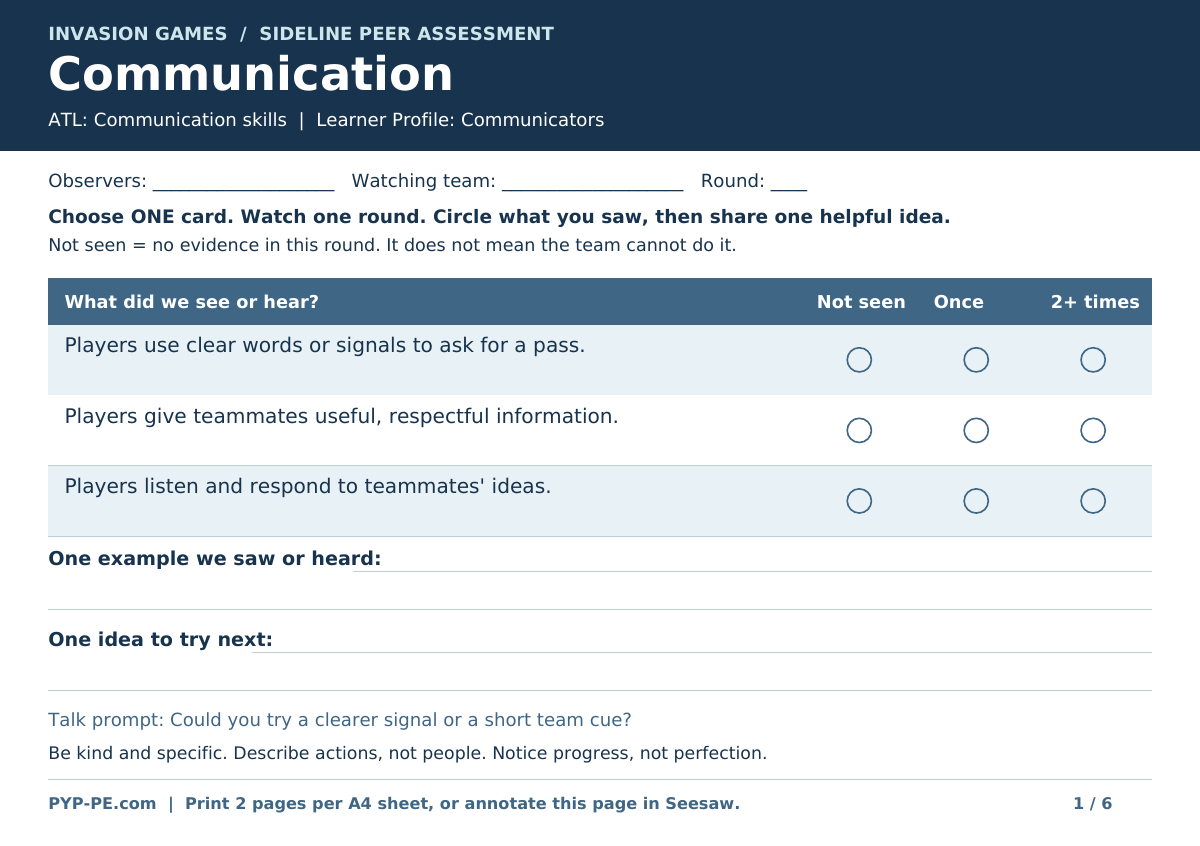
Six small observation cards for waiting teams, linking ATL skills and Learner Profile attributes to game actions.
No resources match these choices. Try another age group or resource type.
Lesson idea / Invasion Games / Grade 1 upwards
Everyone in the game.
4v4 end-zone ball: a practical play–reflect–replay lesson exploring space, support and meaningful involvement.
A personal teaching note
“I use end-zone games with learners as young as Grade 1, adapting the space, team size and rules to help everyone participate. With upper grades, this also works well as an introduction to handball. Later in the unit, adding goals and nets allows the game to develop while keeping the focus on finding space, supporting teammates and including everyone.”
For younger learners, begin with smaller teams, a soft ball and generous passing time. Introduce the everyone-passes challenge when learners are ready.
Twelve student-facing slides guide the warm-up, court setup, rules, first game, tactical practice, inclusion challenge and reflection. Clear diagrams, bold type and the PYP-PE.com blue palette keep the focus on learning.
The deck follows its Google Drive sharing settings. PDF copies are available here.
Waiting teams keep learning
Observers choose one focus, record what they see or hear and offer one next step. Rotate roles each round. Ask teams to test a change and compare involvement.
Set up for success
Equipment: one soft, catchable ball per court, two colours of bibs and flat markers for boundaries and end zones. For 24 students, three courts allow everyone to play 4v4; use short rotating observer roles when space is limited.
Suggested starting space: about 20 × 12 metres with a 2-metre end zone at each end. Adjust to your space and learners: enough room to find passing lanes, without requiring long throws. Leave clear space between courts and nearby walls.
Scoring: catch a teammate’s pass under control in the attacking end zone for one point. Move into the zone to receive; come back out if the pass does not arrive. Either team may enter either zone, with the same non-contact rules.
With the ball: stop, pivot if needed and pass within five seconds. No dribbling or running with the ball. Defenders stay an arm’s length away and intercept passes only; no grabbing or contact.
Turnovers: a dropped or intercepted pass, out-of-bounds ball or five-second violation gives possession to the other team. Restart at the spot, or from the boundary if out; defenders step back. After a score, the other team restarts at its own end-zone line.
The inquiry
How can our team help everyone contribute?
1
Pass, move, show hands · 5 min
In threes, pass and move to a new space. Encourage eye contact, a name or a hand signal before passing. Ask: “How can you give the ball carrier two options?”
2
Set up and agree rules · 4 min
Walk through a goal, turnover and restart. Check understanding with a quick demonstration. Let students explain how they will defend safely.
3
Play and notice · 6 min
Play two short 4v4 rounds with the basic rules. Observe who receives and makes passes and who moves after passing. This is the baseline: do not add the inclusion rule yet.
4
Pause and wonder · 3 min
Give every teammate a voice: “When were you a useful passing option? Who found it hard to get involved?” Ask for one specific moment rather than a judgement about a player.
5
Practise a tactic · 5 min
Use 3v1 keep-ball in a smaller space. Rotate the defender regularly. Encourage scanning, moving after a pass and creating different passing angles. Briefly freeze play: “Where could you move to become an option?”
6
Test the inclusion challenge · 7 min
Return to 4v4. Before a scoring attempt, every teammate must have received and made a pass during that possession. A turnover resets the challenge. Once everyone has done both, the team can attempt a scoring pass. Ask whether the rule creates meaningful opportunities, rather than rushed token passes.
7
Give evidence-based feedback · 2 min
Observers share one action they saw and one useful next step. Teams without observers can discuss their own examples. Keep waiting time brief and rotate players back into the next round.
8
Choose a change and replay · 8 min
Each team chooses one tactical action, such as moving after passing or using clearer signals. Play another round with the same inclusion rule, space and duration to compare the effect of that action. If you need to simplify the rule, explain that the games are now different.
9
Reflect and transfer · 5 min
“I helped our team by… One example was… Our change helped / did not help because… Next time we will…” Invite learners to connect space and support to another invasion game.
PYP-PE.com brings together practical resources and ideas for meaningful, inquiry-led Physical Education.
Explore unit planners, assessment tools, strategy cards, inquiry prompts and student-friendly success criteria, alongside reflections on how these tools can support learning in the gym and on the field.
At the heart of this is a question: how can we create meaningful PE that lives the PYP? PE where students help shape the learning, understand their progress and explore ideas through movement.
Find something to try, adapt and build on with your own learners.
From the gym floor
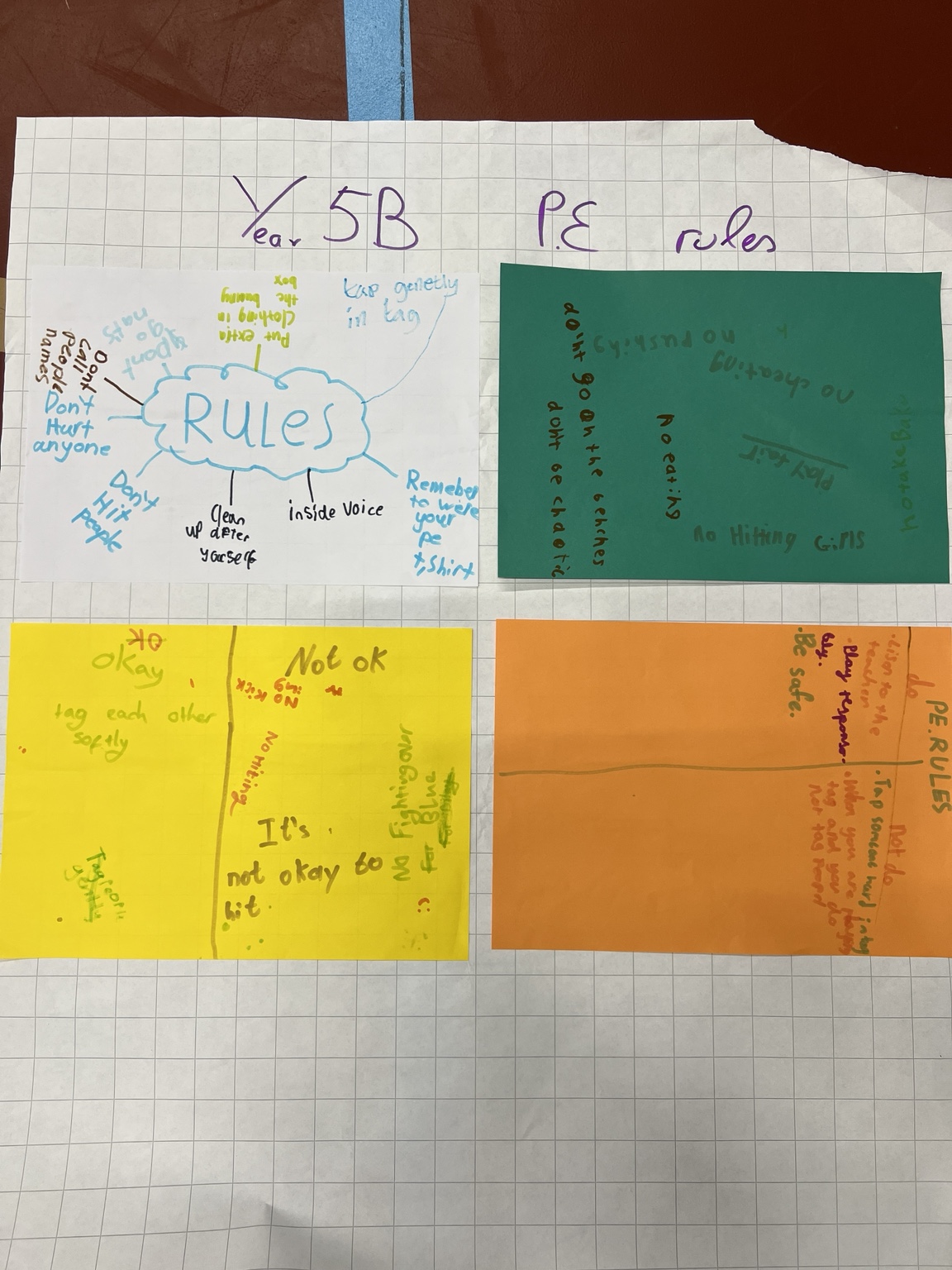
How student voice can shape a shared agreement for PE.
Where is the space? How can you support? What will you try next?
PYP-PE.com
Create & refine
Make it connect.
Choose a balance. Add a way to travel. Link them with control.
PYP-PE.com
Everyone belongs
Help someone join in.
Invite. Listen. Adapt. What can your team change?
PYP-PE.com
Planning tool · Google Sheets
A specialist planner in practice
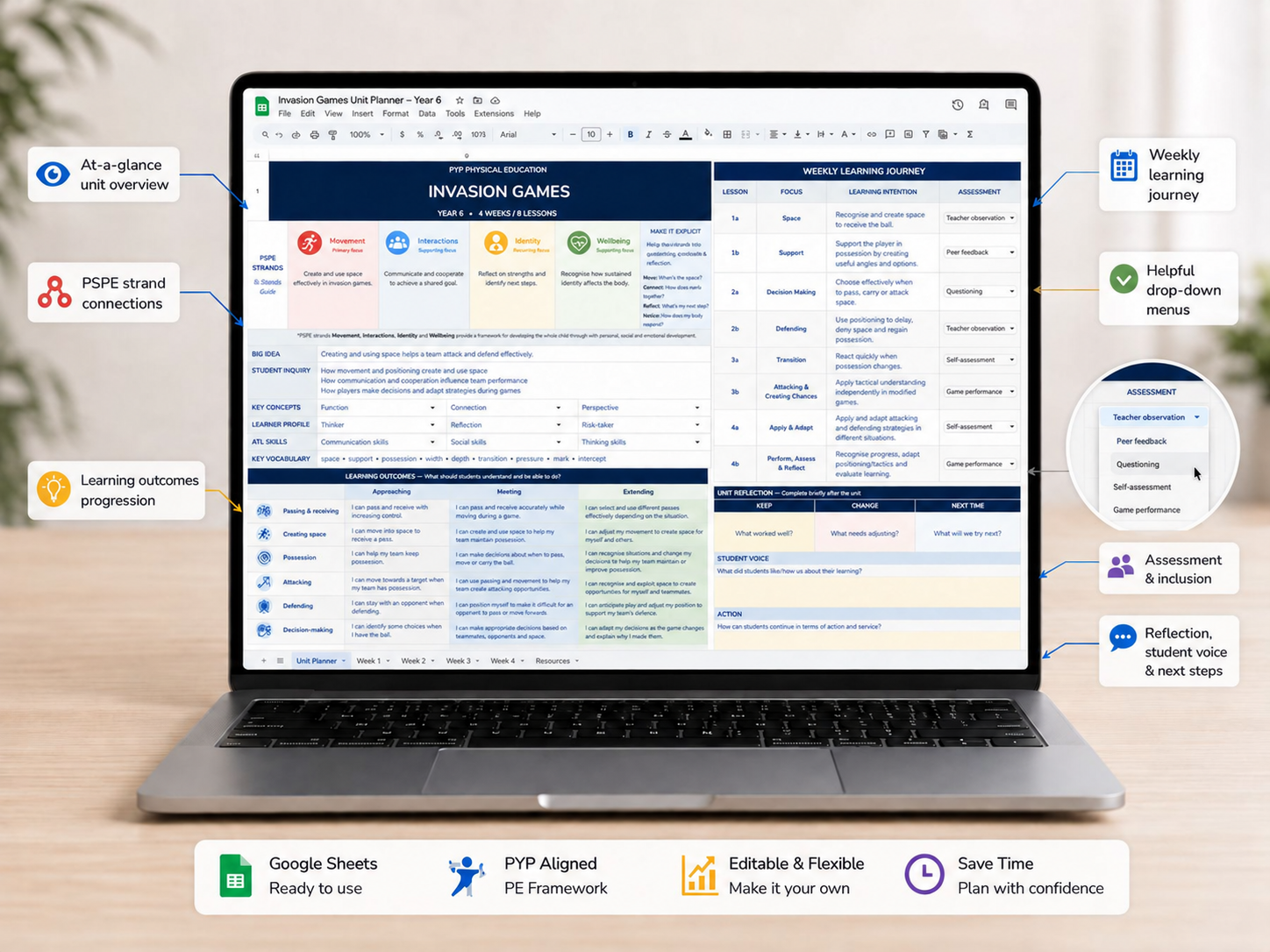
The linked Y6 Invasion Games unit is a completed example of how the specialist planner is used to connect inquiry, learning outcomes and the lesson sequence.
Illustrative preview of the planner layout. Open the Y6 example for the complete working unit.
Designed to be easy to use
Dropdown menus make it easier to select planning elements, while the colour coding, icons and clear sections help teachers find the information they need. The visuals bring the unit overview and learning journey together in a format that is easy to scan.
The Y6 unit shows how the planner can support four weeks of invasion games learning, including student agency, team strategy, PYP concepts, Learner Profile and ATL skills. Supporting tabs provide references for concepts, the Learner Profile, ATL skills and the teacher inquiry cycle.
Use the example to see how the different parts connect, then adapt the approach to the learners, activities and context of another unit.
To adapt the planner, sign in to Google and choose File → Make a copy to save your own editable version.
From the gym floor · Student voice
A gym agreement built with student voice
What do we need from each other to feel safe, included and ready to learn in PE?
A gym agreement begins with this conversation. When students help decide what matters in their shared space, they have a voice in how the learning community works.
Start with their ideas
Invite small groups to discuss, draw and write what a positive PE lesson looks and feels like. Ask what helps everyone join in, what fair play means and how people and equipment should be treated.
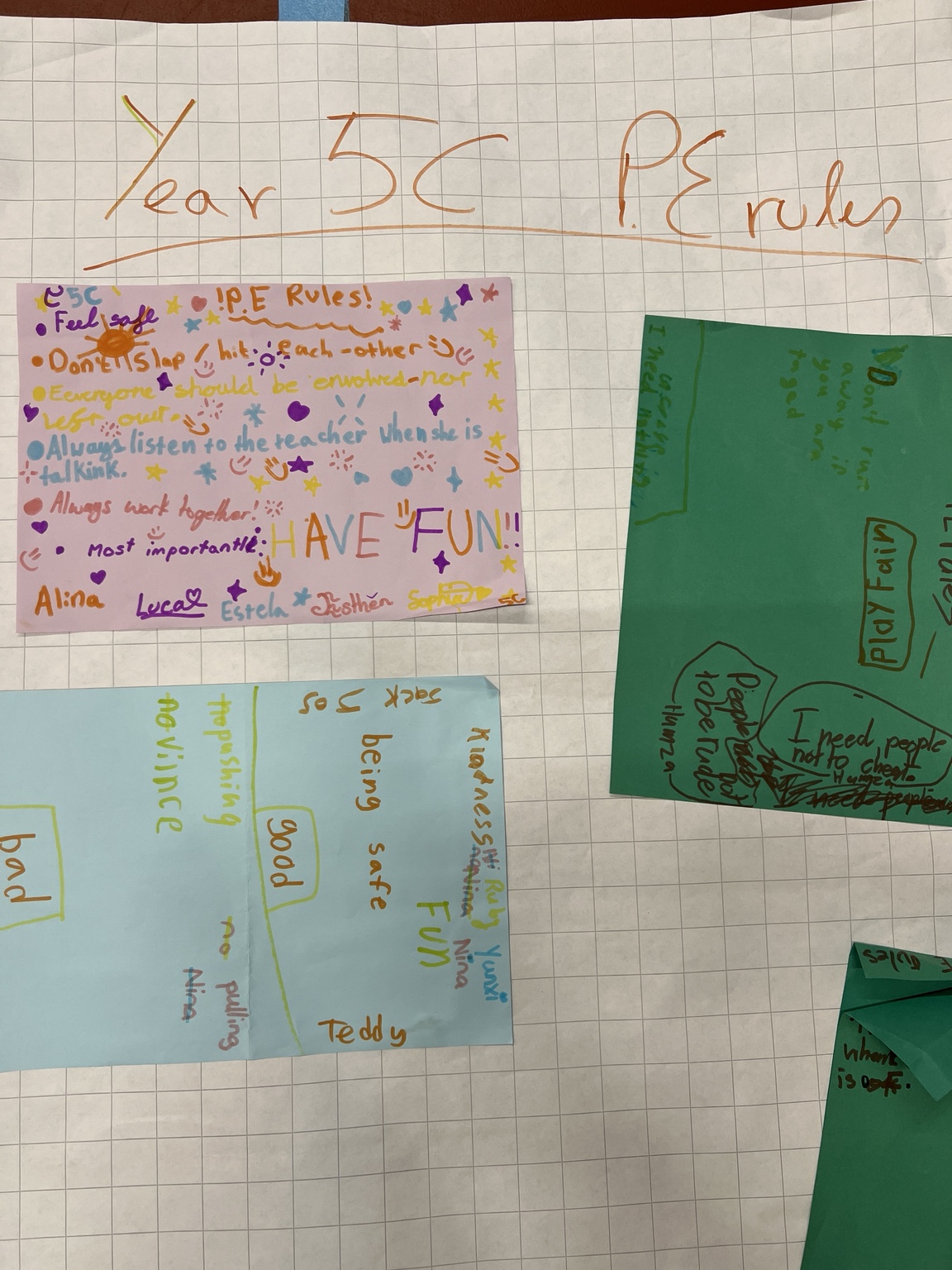
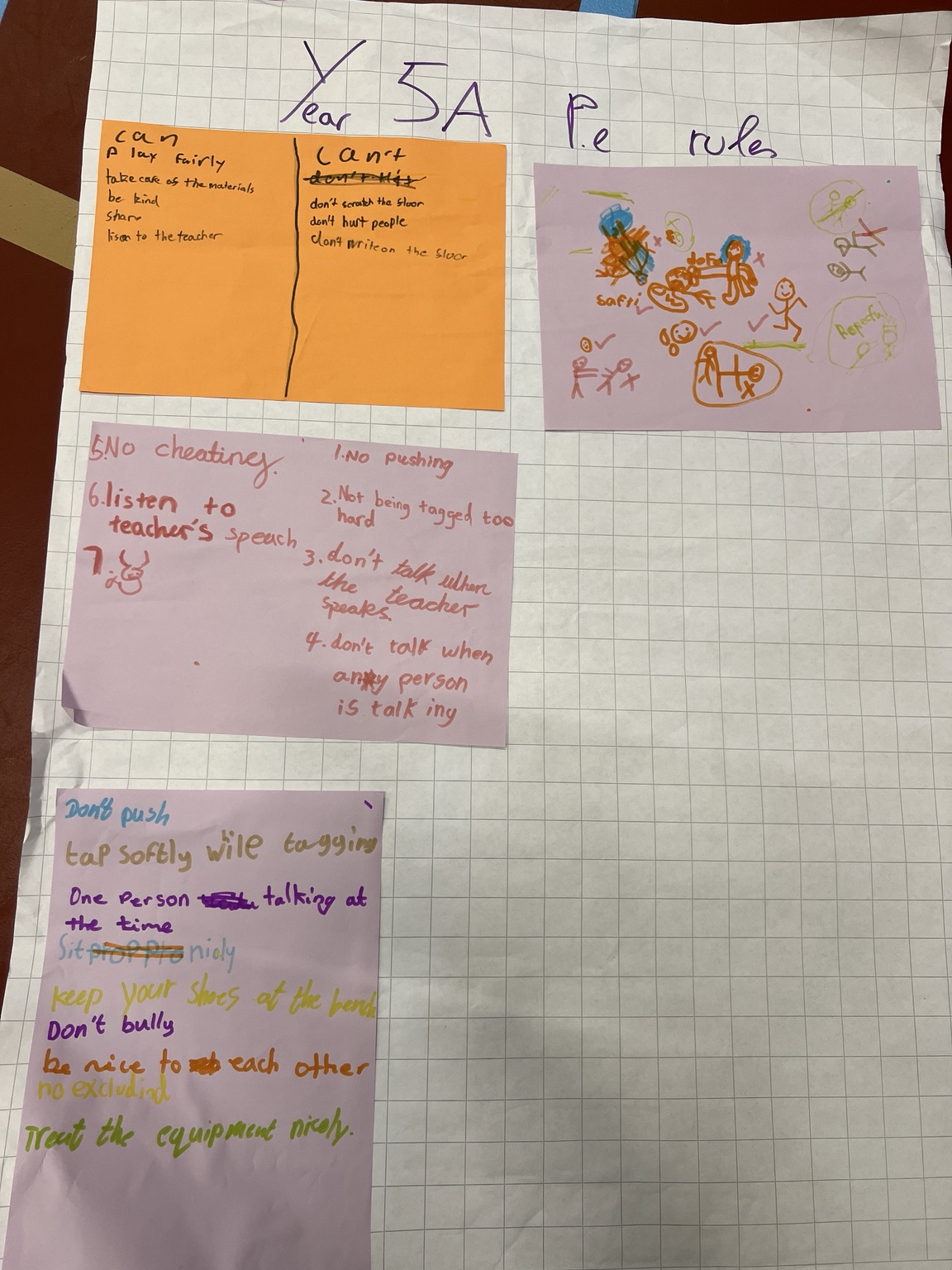
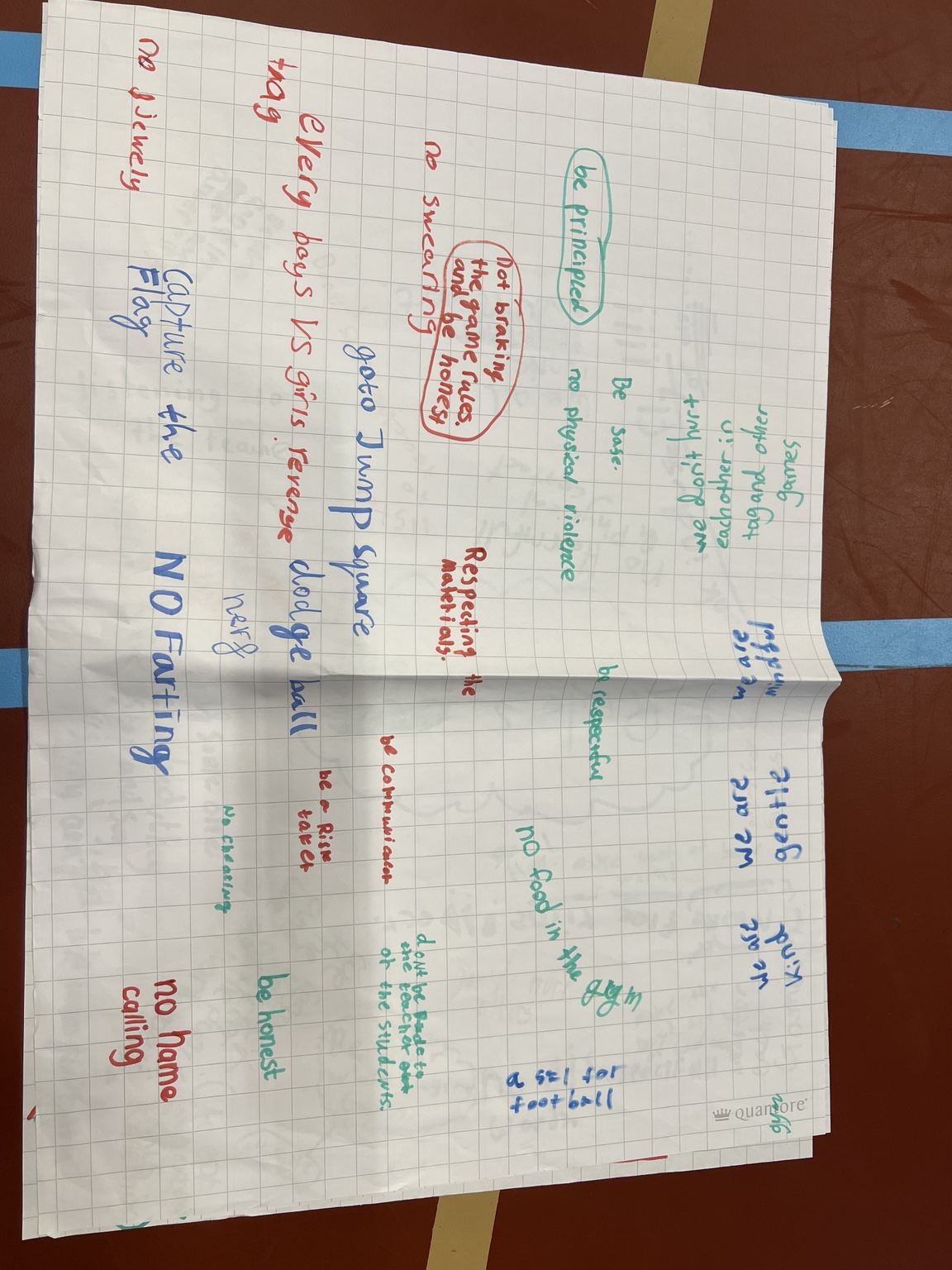
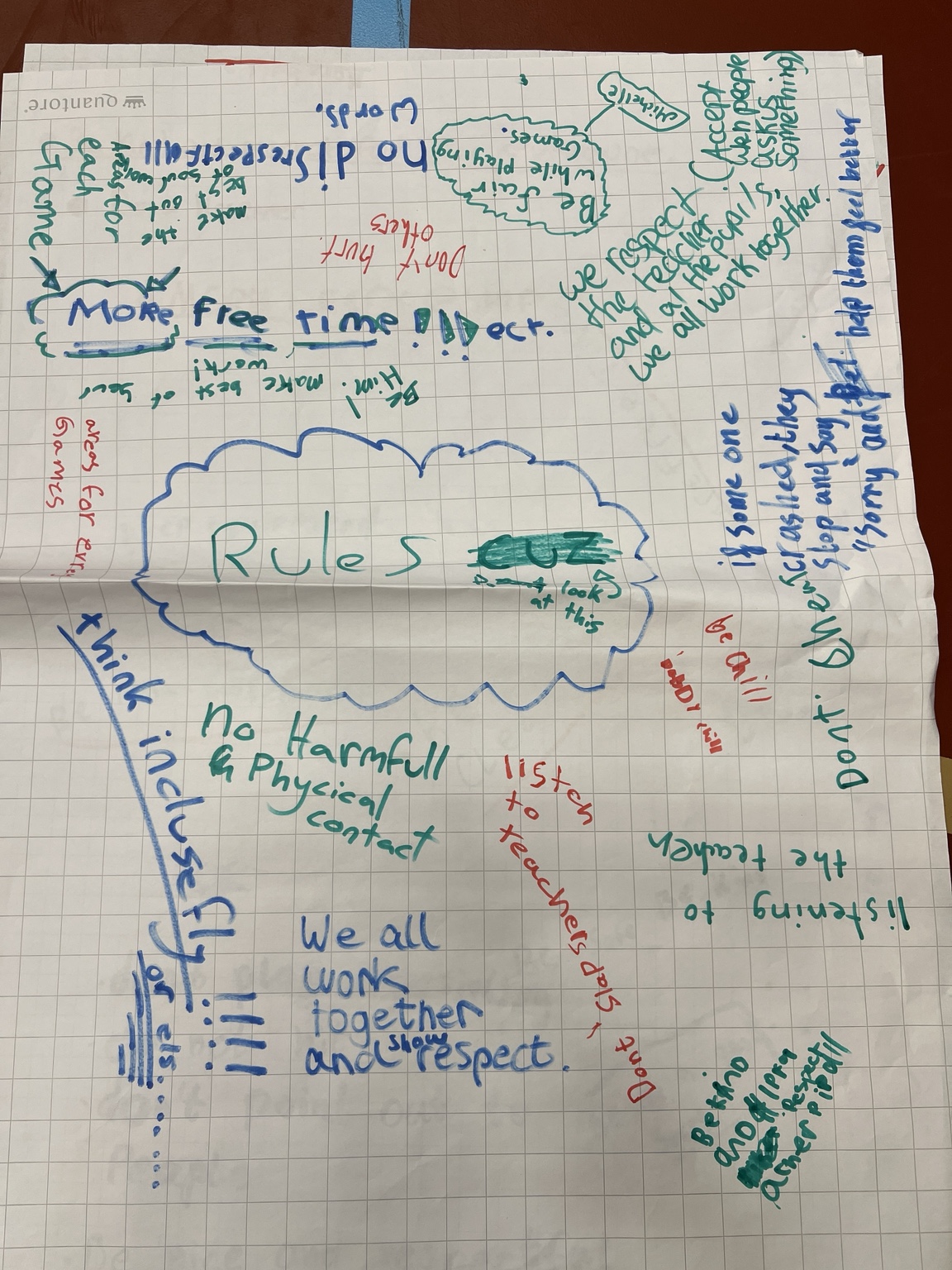
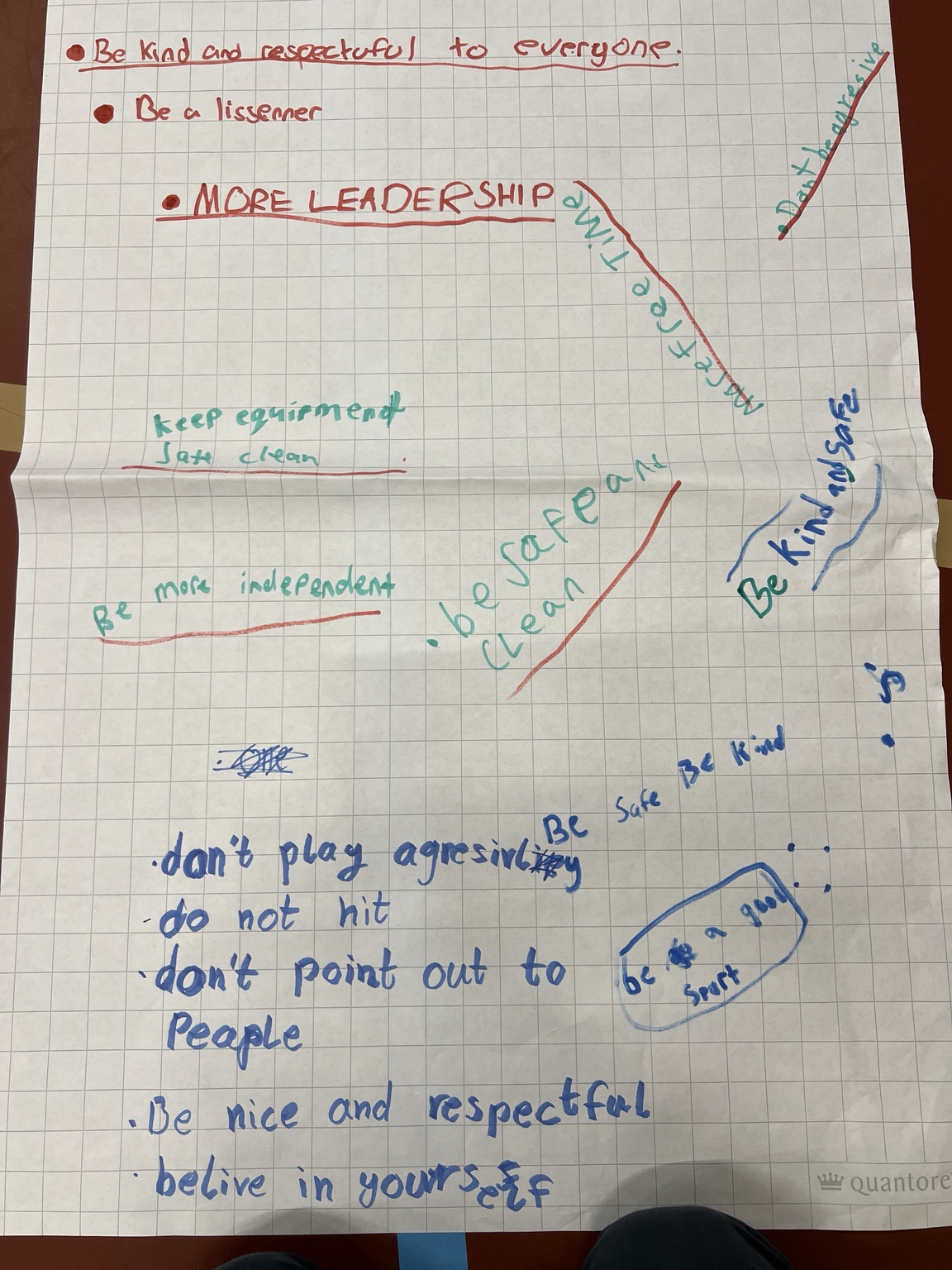
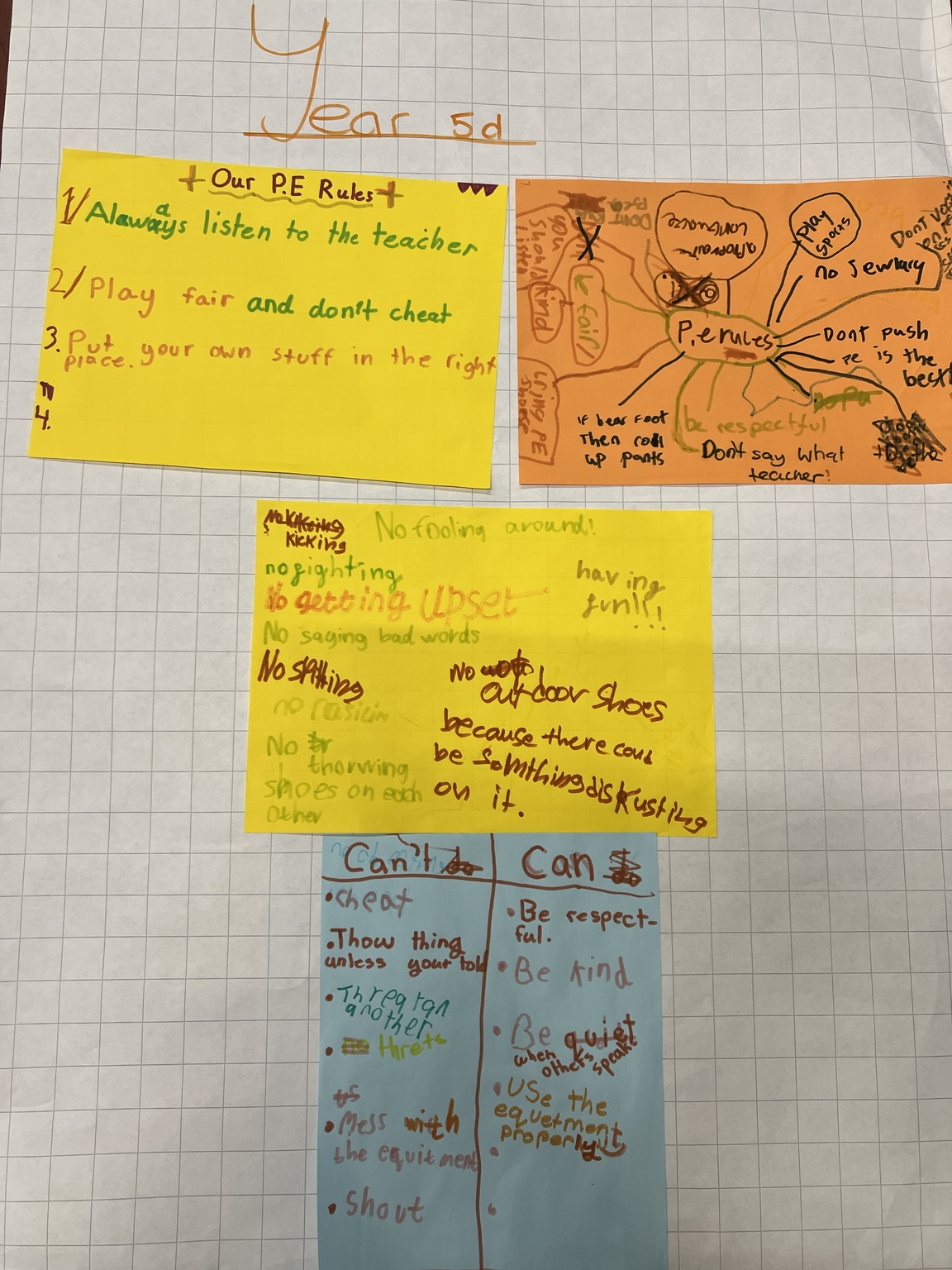
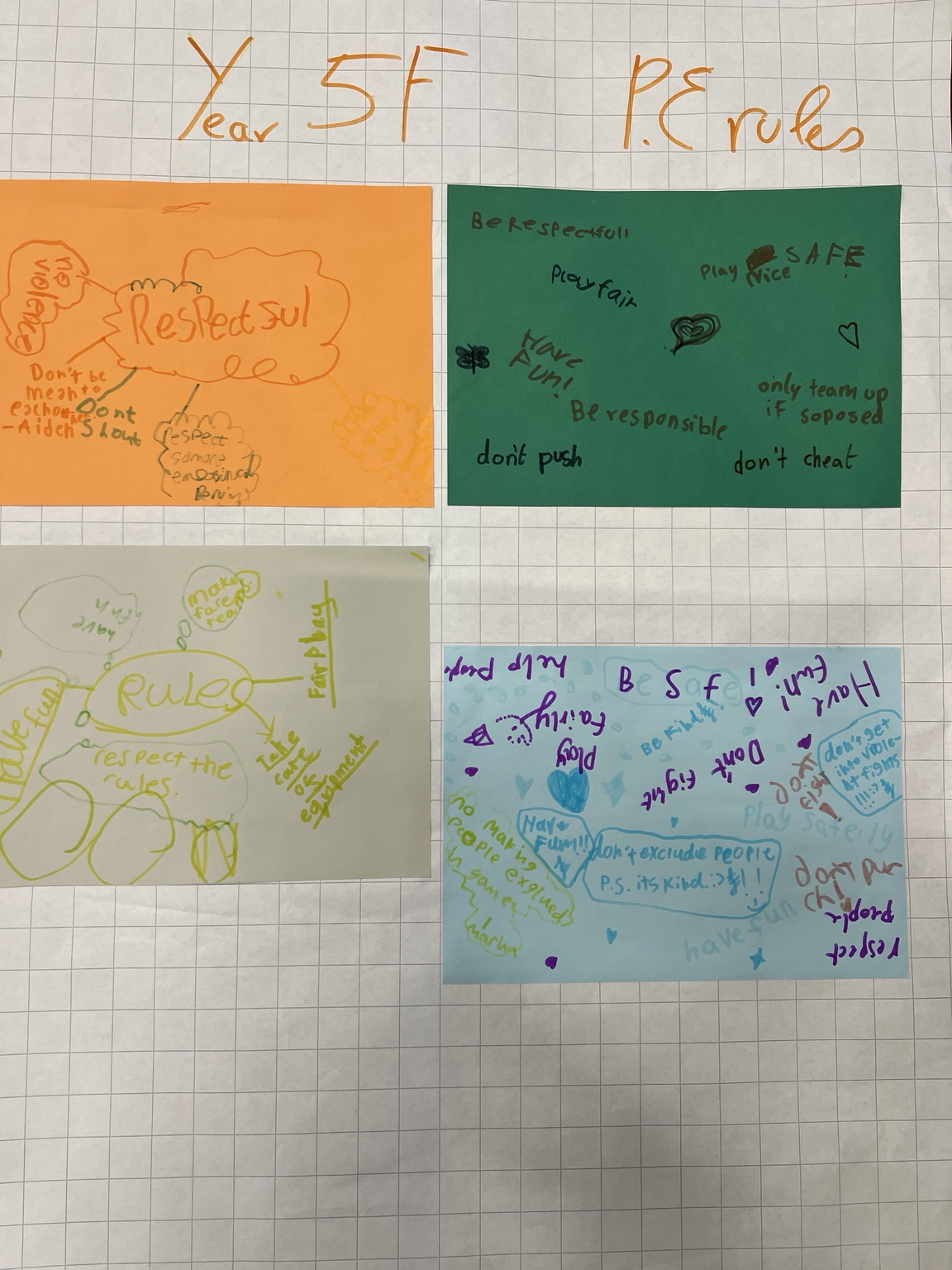
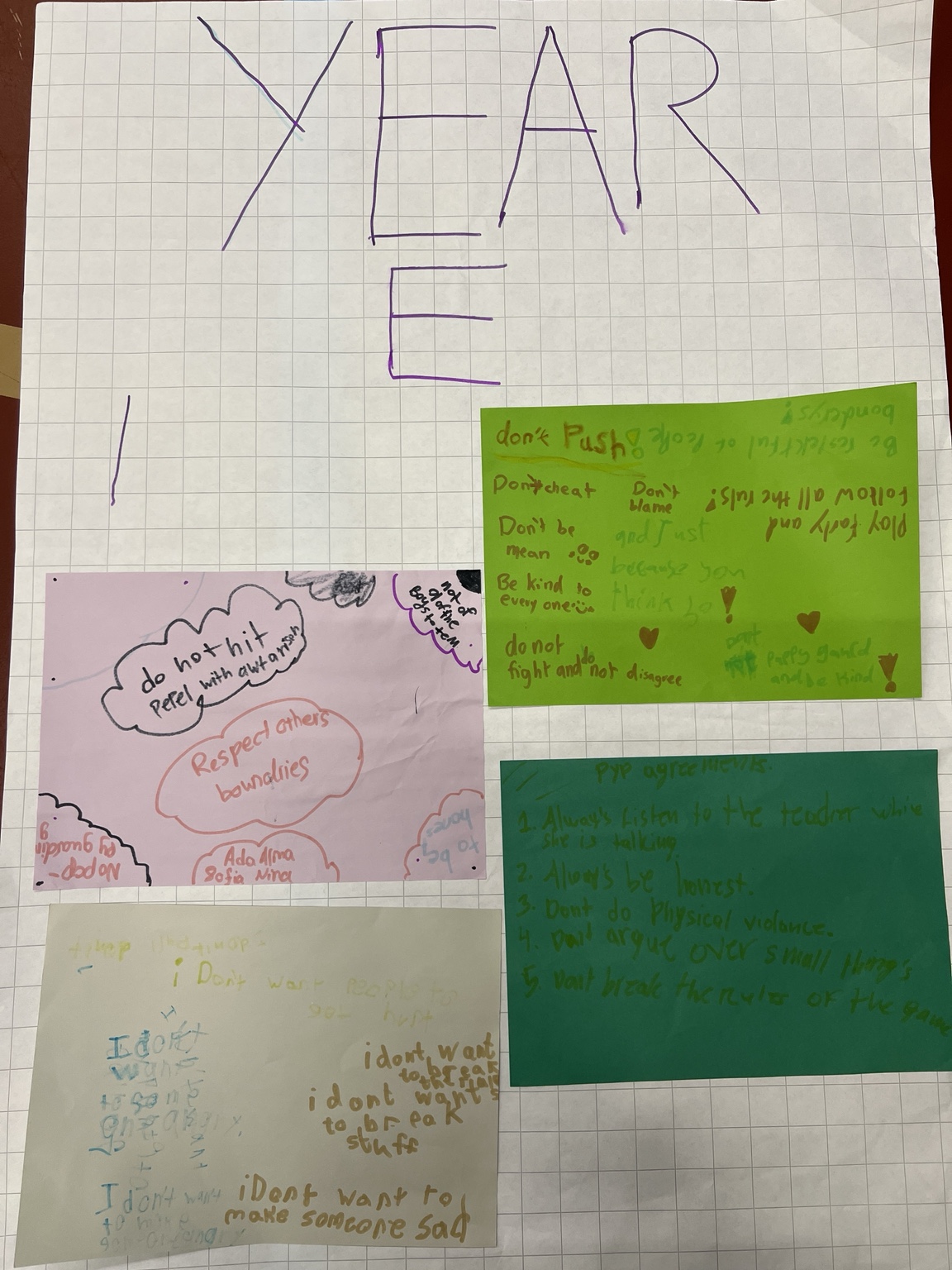
The student posters below return to some clear themes: kindness, inclusion, listening, safety, honesty and responsibility. Bring these ideas together in a short agreement, using language that students understand. Discuss what each promise looks like during a game, a transition or a moment of disagreement.
Make it a shared promise
Print the main poster and invite every class to sign it, draw a mark or add a contribution. Signing gives a visible sense of shared ownership: these are promises the community has helped shape.
The two-page download includes a main display poster and a matching signing poster with space for class signatures. Use it as a starting point, then check that it reflects the ideas and language of the learners who will use it.
Return to it throughout the year. When kindness or taking turns needs attention, ask: “What did we agree? What would that look like now?” Give students a chance to suggest the next step and put their promise into practice.
Revisit it to celebrate, too. Notice a student inviting someone into a game, a team sharing equipment or a group listening carefully. Connect that moment to the agreement so students can recognise how their choices help others learn.
Student agency grows through these everyday opportunities to contribute, act and reflect. The agreement becomes something learners practise together.
The student voices that shaped it
These nine posters show the ideas students contributed. Select a photo to see it in full.
Ideas about respect, honesty and safetyIdeas about teamwork and inclusionIdeas about listening and responsibilityEveryone involved, safe and having funFair play and caring for equipmentSafe, fair and responsible participationBoundaries, honesty and kindnessListening, safety and looking after the spaceSharing, gentle tags and including others
A shared language for the choices we make, the way we learn and how we include one another.
The Learner Profile becomes meaningful when children can connect its language to something they do. In PE, that might be trying an unfamiliar balance, listening to a teammate's suggestion or being honest about a ball going out.
This collection brings all ten attributes into the gym through large, bold titles, clear PE illustrations and short, student-friendly explanations. The wording offers PE examples of the attributes, rather than replacing the IB's full Learner Profile descriptions.
One attribute per page. Print at A3, or choose “fit” to print at A4.
Two posters for shared spaces
For a wall outside the gym, this compact version brings five attributes together on each A3 page. Display the two posters side by side so students, families and colleagues can see all ten PE examples.
An image gives learners a concrete example to discuss alongside the written word. A child can point to the passing signal on the Communicators poster, then demonstrate their own. This offers another way into the language for younger learners, multilingual learners and anyone who benefits from a visible reminder.
Use the posters with movement, modelling and conversation. The aim is to make meaning accessible through several approaches, rather than assign children a fixed learning style. Invite learners to explain what they notice and suggest other examples: each picture is a starting point.
Use them during real teaching moments
1
Choose a purposeful focus
Select one or two attributes that connect to the lesson. Before a new movement challenge, ask: “What could being a risk-taker look like today?” Emphasise safe challenges, asking for support and learning from mistakes.
2
Notice specific actions
Pause briefly when a useful example appears: “You invited someone into your passing circle. How did that help them feel included?” Connect Caring to the action and its effect.
3
Guide the next choice
When a disagreement happens, return to Principled: “What was our agreement? What would an honest, fair decision look like now?” Use the language to support reflection and repair.
4
Let learners explain
End with a short reflection: “Which attribute did your team practise? What did you see or hear? What will you try next?” Learners can speak, point, draw or demonstrate.
A shared language for teachers, too
For teachers new to the PYP, the display provides familiar reference points to return to while planning and teaching. Connect an attribute to the learning intention, model an example and listen for students' explanations. Over time, add examples from the class so the language belongs to the learners as well as the display.
Keep the focus on actions that can develop. The posters are prompts for learning, not labels for judging a child's character.
Independent PE teaching resource by PYP-PE.com. Learner Profile attribute names belong to the IB; PE explanations and illustrations are created for this resource.
Assessment for learning · Student voice · Whole PYP
Small chart. Big questions.
Using KWL charts to find our starting point, listen to learners and return to what matters.
At the start of every unit, I use a KWL chart as a simple pre-assessment. It gives me a starting point: what students think they know, what they want to find out and, eventually, what they have learned. Just as importantly, it gives their questions a place in the planning.
Start with what learners bring
Students usually work in groups of three or four, sharing ideas before recording them on one chart. The small-group conversation matters as much as the writing. I listen for previous experiences, useful connections, uncertainties and ideas we may need to revisit.
I use “What we think we know” for the first column. It makes room for ideas to change. This is a starting point for learning, so an uncertain answer can be just as useful as a confident one.
Let the questions influence the unit
In an Invasion Games unit, one learner might ask, “What are the rules in Ultimate Frisbee?” Another might wonder, “Why is a netball court divided into three thirds?” Those questions offer routes into exploring rules, space, roles and how different games work.
The next step is to show students that their questions have an effect. We might try an adapted game, compare how space is used, or investigate a rule and test what changes when we alter it. Student voice becomes agency when it helps shape a learning experience.
Not every question needs a separate lesson. I look for connections between their interests and the unit’s learning goals, then make those connections visible: “Several groups wondered about this, so today we are going to explore it.”
Return to the chart
Midway through the unit, groups revisit their original ideas. Which questions have we explored? Has anything changed? What are we still curious about? We add dates or use a different colour so the development of our thinking is visible. This check-in also helps me decide what needs more time or a different approach.
At the end, we complete the learned column and reflect on the unit. I encourage students to include an example from a game, discussion or movement challenge: what can they now explain, show or do? Unanswered questions can become starting points for future learning.
Keep it simple and inclusive
Give everyone a moment to think before sharing, then invite each group member to contribute. Learners can write, draw, explain aloud or ask a partner or adult to record their ideas. A group chart offers useful clues; I combine it with individual conversations and observation in PE to understand each learner’s starting point.
The PYP connections happen naturally: Inquirers ask questions, Communicators listen and share, and Reflective learners consider how their understanding has developed. Communication, social and thinking skills are practised throughout; research skills come into play as students investigate their questions.
It is a simple tool, but returning to it makes it valuable. The chart becomes a record of students’ thinking and a practical way to let that thinking guide what happens next.
Download the group KWL resource
The two-page pack includes a spacious group chart and a midway/end-of-unit reflection sheet, with student-friendly Learner Profile and ATL prompts. Use one pack per group of three or four.
UDL stands for Universal Design for Learning. It is a framework for designing learning with different learners in mind, anticipating barriers and offering flexible ways to engage, understand and show learning. In PE, this includes the instructions, routines, choices and assessment opportunities we design.
Following a recent workshop at the International School of The Hague, led by April Remfrey, I have been reflecting on how we design learning in PE. The workshop, Inclusive Practice: Removing Barriers to Learning, invited us to consider the visible and invisible barriers that can affect students’ participation, belonging and sense of safety.
One idea captures the shift in thinking for me:
Look for barriers in the design, rather than locating the problem within the student.
In PE, this means looking closely at our instructions, spaces, routines, equipment and assessment expectations. Who can access the learning confidently? Who might find it difficult, and what could we change?
This connects closely with our PYP work around student agency, approaches to learning, assessment and feedback, and social and emotional regulation. Inclusion runs through the everyday decisions we make about teaching and learning.
UDL provides a framework for making those decisions deliberately: offering multiple means of engagement, representation, and action and expression. These considerations can help more students access the curriculum and demonstrate what they have learned. The CAST UDL Guidelines provide the framework; the PE examples below are my reflections on putting it into practice.
Engagement
Support belonging, purposeful choices and readiness to learn.
Representation
Explain, show and revisit objectives and activities.
Action & expression
Offer different ways to practise and show learning.
1. Show the learning in different ways
A spoken explanation can disappear quickly in a busy gym. Present the objective and the activity through a combination of short wording, graphics, video and demonstration, with something students can revisit.
Display a student-friendly objective with a meaningful graphic.
Use a short, captioned video or a live demonstration. Describe the key movement as you show it.
Add a simple court diagram showing starting positions and movement.
Leave a visual task card at the station so students can check the next step independently.
Ask students to show the first step, so you can check how clearly the task has been explained.
For example, in endzone ball, “move into space” becomes clearer when students hear the cue, watch a player move into an open area and see arrows on a court diagram. Keep slides uncluttered and reveal one step at a time.
2. Make choice manageable
Imagine opening a restaurant menu with hundreds of options. More choice can make deciding harder. Students may feel the same when we ask them to choose their equipment, group, rules and activity all at once.
My planning starting point is a small menu of three to five clearly explained choices, with fewer where helpful. This is a practical guide, not a fixed UDL rule or a limit on what every child can handle. Sometimes two options and a suggested starting point are enough.
Offer three throwing distances, three dance prompts or a few suitable pieces of equipment. Introduce one decision at a time, show what each option involves and allow students to change their choice after trying it. Agency needs enough structure for students to use it.
3. Build routines that support self-regulation
Predictable routines can help students understand what will happen and how to get started. Teach and practise the routines, then check whether everyone can use them.
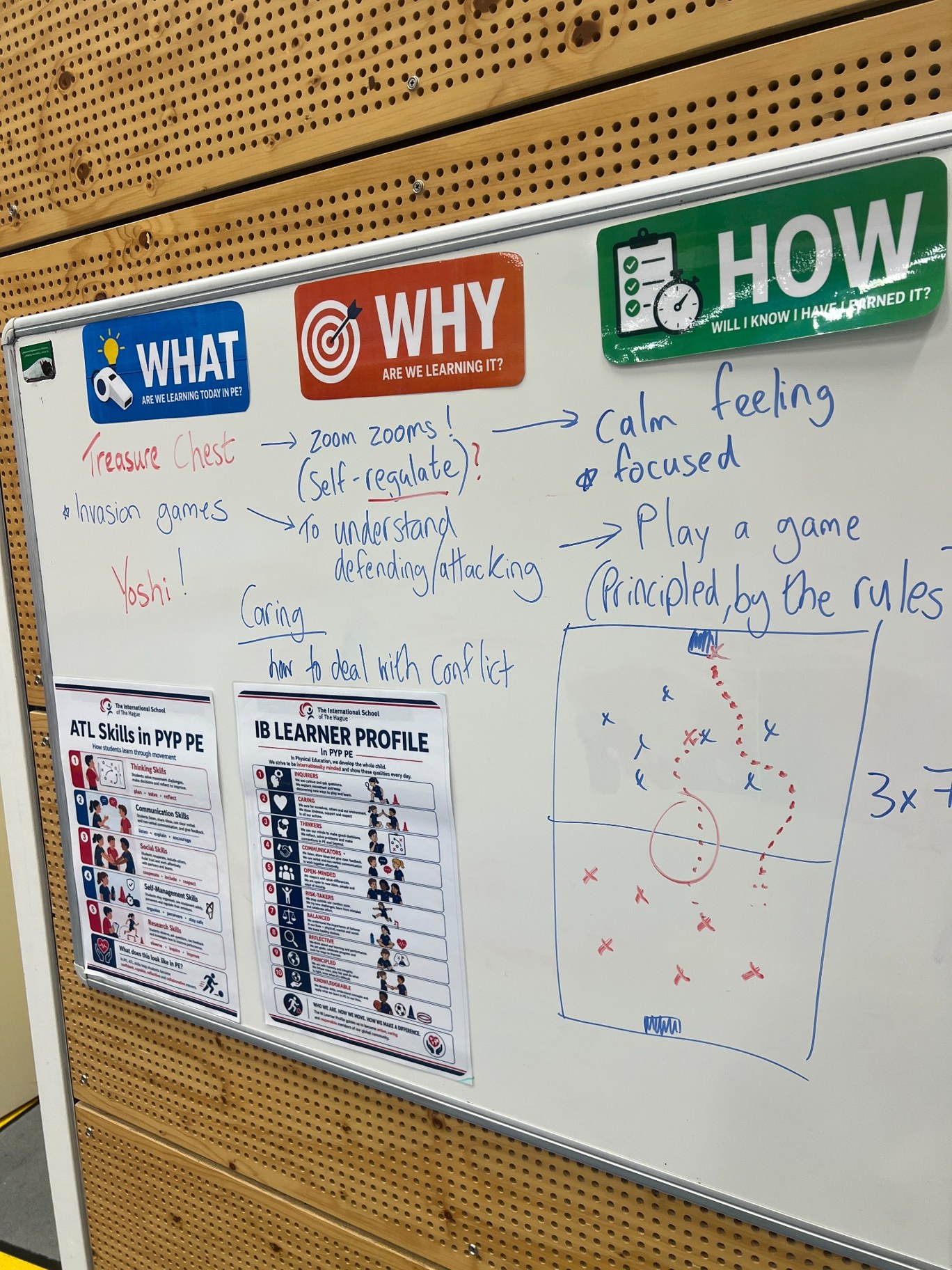
Start with the Treasure Chest
We always open our lessons with the Treasure Chest: time for free play, choice and movement as students arrive. I first got this idea from ThePhysicalEducator.com’s Treasure Time post. I use it to make space for emotional regulation and a familiar, welcoming start to PE.
This is also time to practise sharing, negotiating and working through disagreements, with support when needed. I look for how students are feeling and what might help them move into the next part of the lesson. The aim is to help learners become ready, rather than assume everyone arrives ready in the same way.
Make the learning visible: What, Why and How
Alongside this arrival routine, my board makes three questions visible: What are we learning? Why are we learning it? How will we know we have learned it? We return to these throughout the lesson, connecting the activity to its purpose and what progress might look like. In the example below, the Treasure Chest connects to self-regulation, while invasion games connect to attacking, defending and playing in a principled way.
Our learning board connects what we do with why we do it and how we recognise learning. Select the photo to look more closely.
Gather attention with “waterfall”
When it is time to gather our attention, I say “waterfall” and students make a falling-water motion with their hands. We practise this familiar spoken and visual cue as our transition to full focus. It avoids using a whistle to gather attention, which can feel jarring for some learners.
I check that students can notice and use the cue, allowing time or another accessible prompt where needed. Full focus can look different for different learners; the purpose is readiness to listen and participate.
Show a “Now, Next, Then” outline where it helps students anticipate the sequence.
Agree on a place to pause and a clear way to rejoin the activity.
Use a brief readiness check-in: students can point to a symbol or share a few words.
A pause should be an available support, with help to return to learning. Notice whether the routine helps a student rejoin, ask for support or begin more independently.
4. Make diversity visible in posters and slides
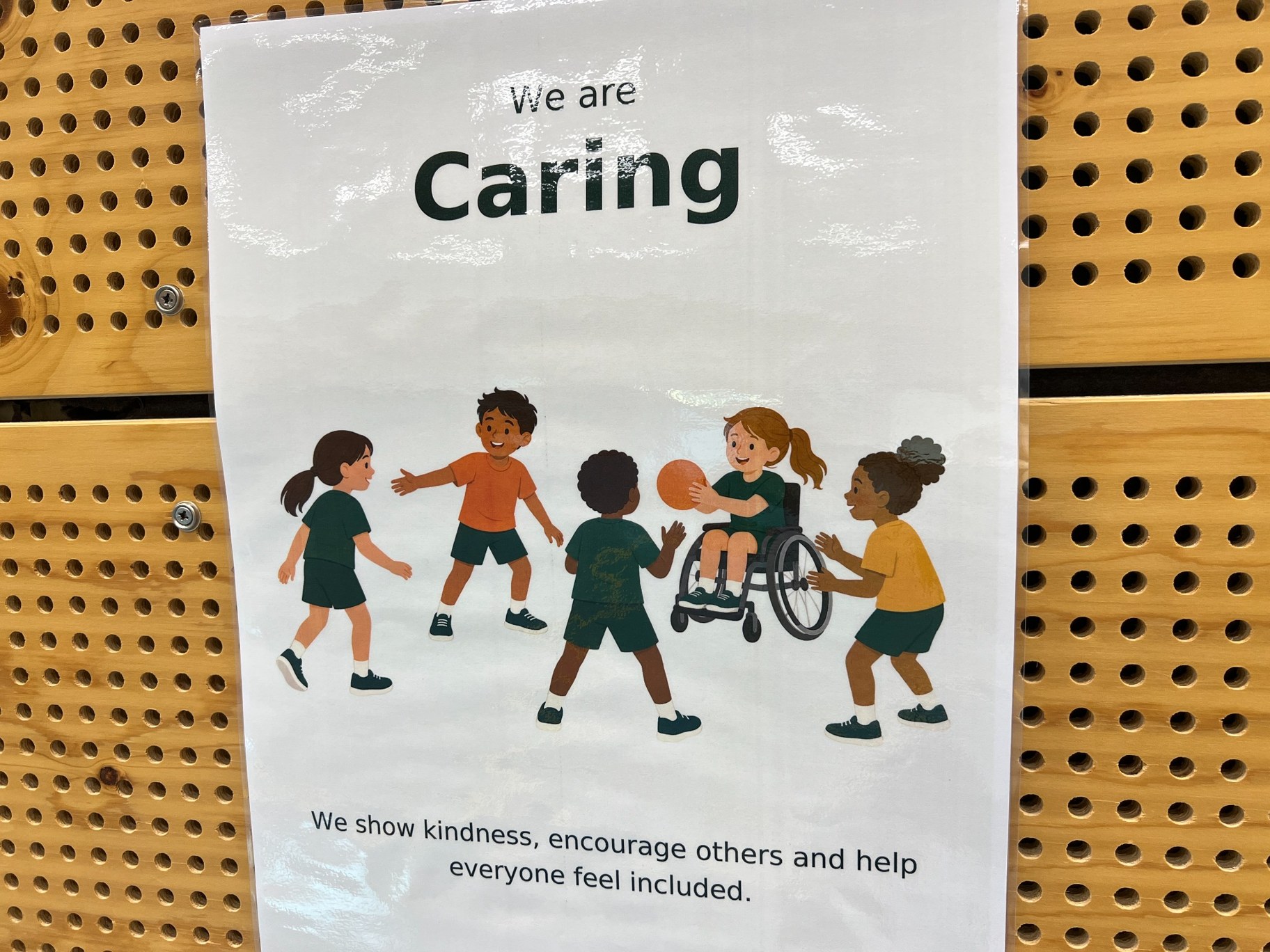
Our displays communicate who belongs in PE. Deliberate diversity means choosing images that represent different bodies, backgrounds, genders and abilities participating meaningfully. Can students recognise themselves as active members of this learning community?
Think about how students access the design, too: readable text, strong contrast, clear spacing and useful graphics. Pair colour with words, shapes or symbols. A station marked with a blue triangle and the word “Balance” offers more information than colour alone.
I have tried to make this deliberate diversity visible in my Learner Profile images. The Caring poster displayed in our gym shows children with different skin tones, including a wheelchair user, taking part together. The image gives us a concrete starting point for discussing kindness, participation and belonging: “Who do you see? How are they including one another? What could that look like in our game?”
Deliberate diversity in the gym: our Caring poster makes meaningful participation visible.
Representation on the wall needs to connect to what students experience in lessons. Use the images to start conversations, invite learners’ own examples and check whose experiences are still missing.
Choose adaptations around the intended learning. For passing, students might select an appropriate ball and adjust the distance between partners. For striking, offer a tee, a self-feed or a partner feed. For movement composition, provide seated or standing possibilities where these meet the objective.
Make these options available as ordinary parts of the lesson. Observe whether each option offers access and a worthwhile challenge, and invite students to tell you what helps.
6. Offer different ways to show learning
At the end of a dance unit, does everyone need to stand at the front and perform in front of the whole class?
I have had students demonstrate their dance in a group, recording it in their own space away from the others. This gave them a more comfortable way to share what they had learned.
Same objective. Different audience.
If the objective is to create and perform a movement sequence, students could perform to the class, to a smaller audience or through a recording. Use the same relevant success criteria across these options.
The evidence still needs to match the objective. A verbal explanation might show understanding of a sequence, but assessing its performance requires evidence of movement. Follow school recording and sharing procedures when using video.
In games, a student could explain a tactical decision by talking, annotating a court diagram or demonstrating it with teammates. If the goal is to apply that decision during play, observe them doing so in the game as well.
7. Use the power of “yet”: practice makes progress
The language we use around difficulty matters, too. I frequently return to the power of “yet” in my lessons. “I can’t do this” becomes “I can’t do this yet”, opening a conversation about growth mindset, practice and what might help us take the next step.
At the start of the year, when I said “Practice makes…”, students would often answer “Perfect!” Now they know my response: “Practice makes progress.” It is a small shift in our shared language that gives us a way to talk about learning without making perfection the expectation.
We can connect that language to something specific: a more controlled pass, a new strategy, asking for help or trying a useful piece of feedback. “Yet” is an invitation to find a next step, with the time, support and adaptations a learner needs. It should never become pressure to keep repeating a task that is inaccessible.
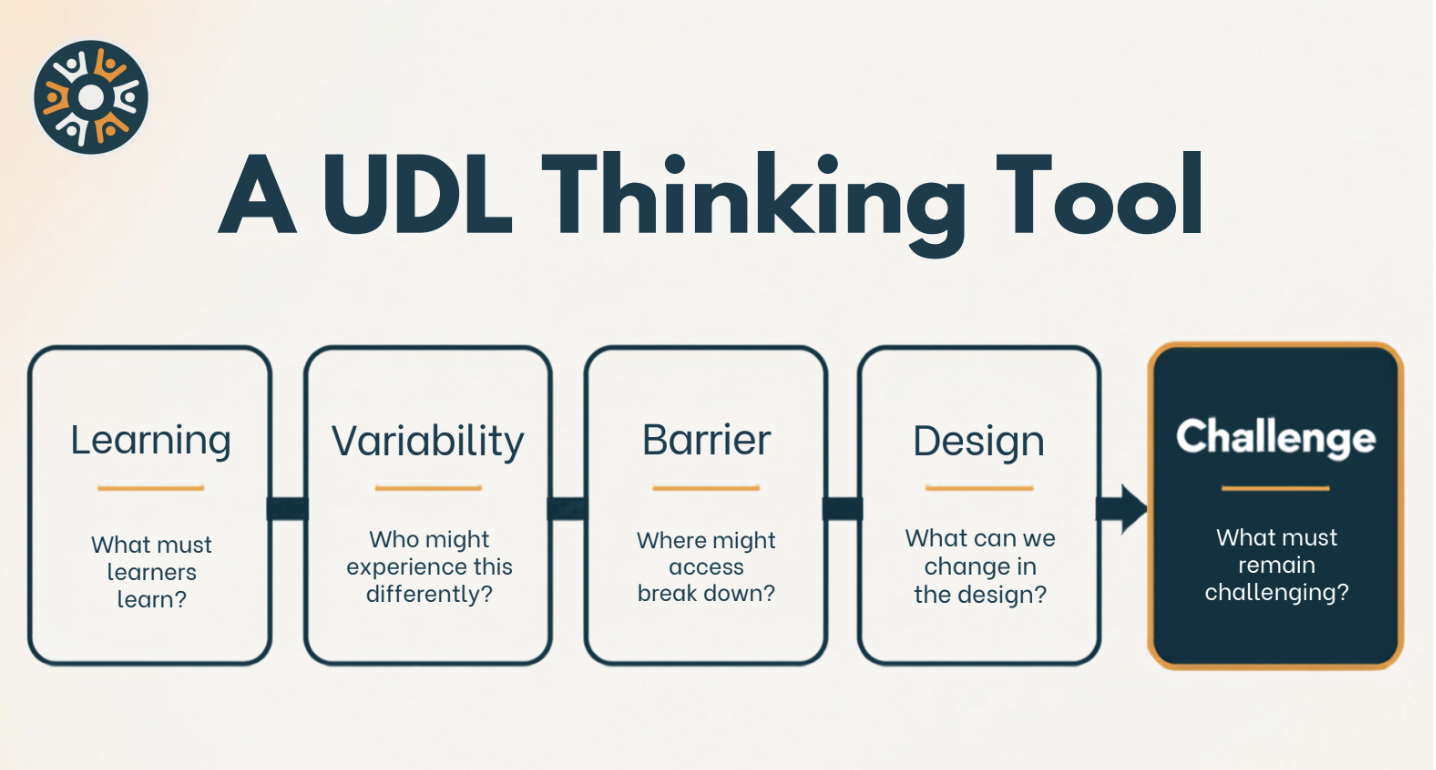
8. Give UDL a place in the unit planner
“A UDL Thinking Tool”, shared by April Remfrey during the workshop at the International School of The Hague.
A dedicated UDL section makes space to anticipate barriers before teaching begins. Alongside objectives, learning experiences and assessment, include the barrier, the planned response and what you will look for to judge whether it helped.
A worked example: creating and performing a dance sequence
Planning focus
What I could include
Learning goal
Create and perform a sequence with a clear start, transitions and finish.
Anticipated barriers
Remembering a spoken sequence; too many starting ideas; performing before a large audience.
Representation
Movement cards, a short captioned example and a live demonstration of a transition.
Engagement
Three starting prompts, a predictable rehearsal routine and an agreed pause-and-rejoin process.
Action and expression
A live class performance, a smaller audience or a group recording, assessed against the same movement criteria.
What I will notice
Who begins independently, who uses the supports, whose learning becomes visible and what students say helped.
This could sit within the unit planner as a regular planning prompt. Revisit it during the unit: a planned support only becomes useful when it works for the learners in front of us.
More UDL thinking through a PE lens
Matt Magowan is doing some fantastic work exploring UDL through a PE lens. I recommend Loui Lord Nelson’s UDL in 15 Minutes with Matt Magowan post, which shares ideas from their conversation about learner agency, purposeful choices, explicitly taught skills and making growth visible. It is a useful next read for PE teachers considering how these ideas could work in their own setting.
One change to try next
The question I am taking into my own practice is: What might I try differently, and what will I notice in my students as a result?
Start with one lesson. Make an instruction available in another format, simplify a choice or offer an alternative audience for a performance. Ask students what helped them participate and show their learning. Use their responses to shape the next lesson.
Further reading: CAST Universal Design for Learning Guidelines. This post shares my own reflections following the workshop and includes the workshop thinking-tool image shared above; the PE examples and reflections are my own.
Give waiting teams a small, purposeful focus: watch one aspect of play, notice evidence and offer a useful next step.
These six mini observation rubrics connect approaches to learning (ATL) skills and Learner Profile attributes to actions students can see and hear. They suit Years 3–6, with adult modelling and fewer criteria where helpful.
One card, three observable actions, an example and one next step.
Choose one focus
Communication: communication skills and Communicators.
Cooperation and inclusion: social skills and Caring.
Tactical thinking: thinking skills and Thinkers.
Self-management and fair play: self-management skills and Principled.
Reflect and adapt: thinking skills and Reflective.
Investigate the game: research skills and Inquirers.
A simple watch–feedback–replay routine
Choose: agree one card with the playing team before the round. Read the three actions together.
Watch: observers circle “Not seen”, “Once” or “2+ times”. Divide the criteria between observers if that helps. Record one specific example.
Share: during the break, say “We noticed…” and “You could try…”. The playing team can explain what they noticed too.
Replay: the team chooses one next step to test. Rotate roles so everyone returns to playing.
The reflection and research cards need access to the team huddle as well as the next round. For research, agree a small question such as “Are we using both sides of the court?” and gather a tally, sketch or example.
Evidence, not a team score
These are observation snapshots, not grades or rankings. “Not seen” means there was no evidence in that observation period; the opportunity may not have occurred. Repeated actions are not automatically better in every situation. Discuss whether an action helped, and describe behaviour rather than judging a learner’s character.
Print small or use in Seesaw
Print: each PDF page is an A5 landscape card. Choose two pages per sheet on A4 portrait paper to make six cards on three sheets. Cut in half, or laminate for reusable dry-wipe cards. Print one page per sheet if students need larger text or more writing space.
Seesaw: upload the PDF to an activity and use the relevant card page. Students can circle their observations and add evidence by typing, drawing or recording a short voice response, using the tools available in your class setup. Give each team one card rather than asking them to complete all six. See Seesaw’s PDF upload guide for help.
Model one example first: “We saw a player move wide and signal for a pass. That gave the player with the ball another option.” Let students point, speak or work with a partner to record their feedback.